Along one of Bengal's most historic riverbanks
Location Category
Location Circuits
Location Interest
Location How Many Days
Location Group
Location Content
Text Body
Few stretches of the Hooghly river pack as much history, architecture and quiet grandeur into so compact a zone as the Bansberia-Tribeni Belt. Wedged between the industrial outskirts of Kolkata to the south and the old colonial river towns to the north, this twenty-kilometre corridor of the river's western bank is home to some of the most dazzling terracotta temples in Bengal, the sacred confluence where three rivers meet, the ghosts of a long-gone Portuguese trading post and mango orchards that seem frozen in a gentler century.
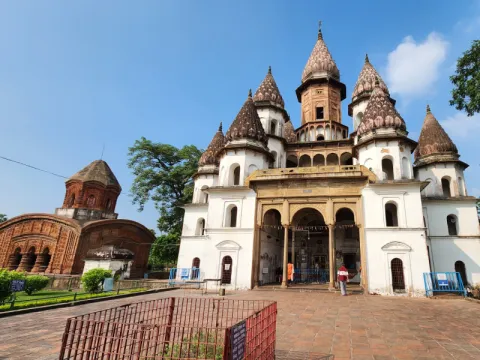
Yet most visitors whip past on the NH-12 or aboard the Bandel-Katwa local, barely glimpsing the moss-green shikhars rising above the riverside palms. Those who stop are rewarded with a living museum of Bengal's layered past: Vaishnavite shrines built by zamindar patrons in the seventeenth and eighteenth centuries; crumbling Armenian and Portuguese ruins; active river bathing ghats where priests still chant at dawn; and a temple complex, Hangseshwari, so breathtakingly eccentric it stops even jaded India hands in their tracks.
The belt is also one of the last pockets of old-fashioned Bengali river culture. Farmers still pole flat-bottomed noukos across the Hooghly; country boats carry loads of earthen pots and bamboo; and the smell of mustard oil, marigold garlands and incense mingles with the damp river air at every turn.
History in Brief
The confluence at Tribeni has drawn pilgrims since at least the seventh century, when the Gupta-era sage tradition celebrated the meeting of the Hooghly (Bhagirathi), the Jamuna and the now-largely-silted Saraswati rivers as a tirtha, a sacred ford that strips away sin. Early medieval inscriptions record Buddhist monasteries and Hindu temples lining the banks. By the fifteenth century, the area had become one of Bengal Sultanate's administrative satellites and traces of that era survive in a fourteenth-century mosque that still stands, somewhat overlooked, behind Tribeni's main ghat.
Bansberia rose to prominence under the Datta Roy zamindars in the seventeenth century. The two great temple complexes, Hangseshwari and Vasudeva, were constructed in 1814 and 1679 respectively, the former conceived in a visionary tantric idiom unlike anything else in Bengal. The zamindari system's collapse in the twentieth century left the area in productive obscurity: rich in relics, light on tourist infrastructure and quietly magnificent.
Title
History and Culture
Is Background Visible
Off
Location Information Items
Section Title
Top Sights and Experiences
Text Body
Getting There
By Train (Recommended): The most comfortable and reliable way. Take the Howrah-Katwa local or any Howrah-Burdwan Main Line train from Howrah; Bansberia is 50-75 min, Tribeni is 70-90 min. Trains run frequently (30-60 min peak). The Rs. 20-35 second-class ticket is a Hooghly travel bargain. Sit on the right (river-facing) side going north for views.
By Road: Private taxis from central Kolkata take 90-120 min (Rs. 1,200-1,800) depending on NH-12 traffic (negotiate). State buses from Esplanade are slower and less comfortable than the train, with 2-3 hour journeys common in traffic.
Getting Around
Autorickshaw: The main local transport. Shared autos run fixed routes between Bansberia and Tribeni. A hired, non-shared auto for the day is best for covering the area at your pace. Pre-negotiate the full-day rate, confirm stops are included and agree on meeting/return times.
Cycle Rickshaw: Available in town centers for short trips or slightly longer ones. Pullers often have good local knowledge and some basic English.
On Foot: Bansberia and Tribeni's main sights are within a 15-20 minute walk of each other. Walking the 8 km embankment road between the two is feasible in cooler months for river views, but lacks shade and has uneven sections.
By Boat: Country boats (nouka) cross the Hooghly, mainly for locals. Hiring a boat for a river excursion is possible at Bansberia and Tribeni ghats; bargain hard. Be aware the boatman may pick up extra passengers, which is normal.
What to Eat
Cuisine is river- and agriculture-based. Freshwater fish (hilsa, rohu, catla, prawns) are central, appearing in curries, mustard gravies (shorshe) and fried dishes. A typical thali includes rice, dal, a vegetable (aloo posto is common), fish and sometimes a sweet.
Hooghly is known for sweets (mishti):
Mishti doi: Jaggery-sweetened, thick, earthen-pot set curd.
Sandesh: Rustic, freshwater-chhena fudge.
Nolen gur sandesh: Seasonal (Nov–Feb) date-palm jaggery sandesh.
Payesh: Rice pudding with full-fat milk and nolen gur, served cold.
Best Time to Visit
The best time to visit is October to March, with November-January being the peak. During this time, the weather is cool and dry (18-26°C daytime, 12-15°C night), the river is manageable and the low-angled winter light is picturesque. This season also coincides with nolen gur (date-palm jaggery) production, adding a smoky-caramel scent to the air.
January is notable for the vibrant Makar Sankranti festival (Jan 14th-15th), which draws huge crowds for bathing at the Tribeni sangam ghat, creating a lively temporary mela.
February and March are still excellent, though afternoons warm up by mid-March. The Dol Jatra (Holi) at Vasudeva Temple, usually in March, is a highly recommended local festival.
April and May are very hot (38-43°C) and humid, making outdoor exploration difficult. Visits during this period should be structured around pre-dawn and post-sunset hours, avoiding 11 am to 4 pm.
June through September is the monsoon season. Rivers swell, the Tribeni ghat can be submerged and road access may be disrupted. While the landscape is dramatically green and romantic, the heat-humidity combination is punishing. Experienced travellers may find September, as the monsoon eases, a less crowded and rewarding time.
October is an underrated transition month. The monsoon retreats, humidity drops and Durga Puja fills the area with lights and celebrations. Temperatures are still warm (low-to-mid 30s) but the cool evenings return. The illuminated ghats during Durga Puja immersion are a beautiful sight.
Title
Things to Know
Is Background Visible
Off
Location Images
Image
Location Banner Image
Image