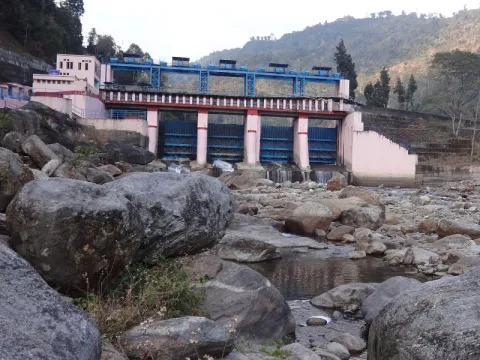
The Bindu Dam, a concrete barrage across the Jaldhaka at the point where the river touches the Indian border, is the valley’s single most dramatic sight. The dam was constructed to feed the Jaldhaka Hydel Project at Jhalong and is also used as a footbridge, allowing pedestrians to walk over the river right up to the Bhutan border (note: this is not an official immigration checkpoint and tourists are not permitted to wander into the adjacent Bhutanese forest). From the dam wall, the view upstream into Bhutan is arresting: the river emerges from a tight gorge between densely forested hills, its white water churning over boulders, the Bhutan Himalayas framing the background.
On clear winter mornings from December to February, the snow-capped peaks of the Bhutan range are visible from the dam site in extraordinary clarity, lit gold by the early sun. Bring your best camera and arrive before 9am.
The confluence of the three streams, Bindu Khola, Dudh Pokhri and Jaldhaka, at the dam site is a spectacle in its own right. Each stream has a slightly different water character: the Dudh Pokhri (‘Milk Lake’ in Nepali) carries glacial silt that turns it milky-white after heavy rain; the Bindu Khola runs clear and cold; and the Jaldhaka, the largest of the three, has the blue-green tint of a deep mountain river.
Article Content
Text Body
Is Background Visible
Off
Published on
Article Image
Image
Updated On
Read Time
5
Article Type
Location
Article Videos
Is Background Visible
Off
Upload Video
Content Family
General Purpose
Image Gallery
Upload Images
Is Background Visible
Off
Images View Mode
Simple
Video Gallery
Is Background Visible
Off
Upload Video
gallery view mode
horizontal
action if location
default
Comments