Hangseshwari Temple (Hamseshwari Mandir)
Hours: Dawn to dusk daily; puja at approximately 5:30-7:00 am and 5:00-6:30 pm
Entry: Free (small donation box inside)
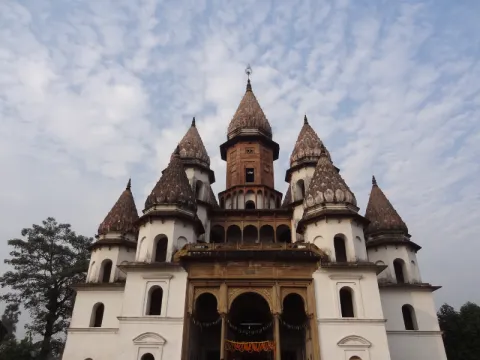
If you see only one sight in the belt, make it this one. Built in 1814 by Raja Nrisingha Deb, Hangseshwari (‘Goddess Who Resides in the Swan’) is an act of architectural audacity without parallel in Bengal. Thirteen lotus-bud shaped towers, the central one soaring some twenty-seven metres, erupt from a single plinth like a cluster of rockets about to launch, each tower representing one of thirteen elements of the subtle human body as conceived in Tantric philosophy: the five organs of action, five sense organs, mind, intellect and ego. The overall effect, especially at first light when mist curls off the Hooghly and the vermilion-red shikhars glow against the grey sky, is genuinely otherworldly.
Construction proceeded slowly; when Raja Nrisingha Deb died in 1802, only the lower storeys had been completed. His widow, Rani Shankari, took up the unfinished project and saw it through to completion in 1814, three decades after her husband laid the foundation stone. Inside, the principal deity is Hangseshwari herself, a rare, composite tantric form of the goddess, housed in a sanctum whose walls are covered in intricate stucco motifs. The outer courtyard is dotted with minor shrines and a large Shiva linga pool. Priests conduct puja at dawn and dusk; if you arrive at those hours you may witness offerings of hibiscus, sweets and conch-shell music in the half-dark.
Vasudeva Temple (Ananta Vasudeva Temple)
Hours: Dawn to dusk daily
Entry: Free
Standing directly opposite the Hangseshwari complex across a narrow lane, the Vasudeva Temple was built in 1679 and represents a completely different aesthetic tradition: the eka-ratna (‘single jewel’) style of Bengal's terracotta renaissance. The temple rises on a single storey featuring traditional curved cornices, topped by a single octagonal pinnacle. Its surfaces are covered in a dense frieze of terracotta panels depicting the ten avatars of Vishnu, scenes from the Ramayana and Mahabharata, erotic couples (mithuna), Portuguese soldiers complete with feathered hats and muskets and oddly charming scenes of daily seventeenth-century Bengali life: a woman oiling her hair, musicians at a festival, men smoking hookahs.
These panels are among the finest examples of Bengal terracotta narrative art surviving anywhere and unlike similar work at Bishnupur (which draws vastly more visitors), you will likely have them almost entirely to yourself. Bring a small flashlight and take the time to walk the exterior walls methodically as the Portuguese-soldier panels on the northern face are especially remarkable and easy to miss.
Article Content
Text Body
Is Background Visible
Off
Published on
Article Image
Image
Updated On
Read Time
5
Article Type
Location
Article Videos
Is Background Visible
Off
Upload Video
Content Family
General Purpose
Image Gallery
Upload Images
Is Background Visible
Off
Images View Mode
Simple
Video Gallery
Is Background Visible
Off
Upload Video
gallery view mode
horizontal
action if location
default
Comments