The story of this land begins not in Balurghat but at Bangarh, the ancient city known as Kotivarsha. From the evidence of the Damodarpur copper-plate inscriptions, archaeologists have established that Kotivarsha served as the administrative capital of the Kotivarsha Vishaya, a territorial division within the vast Pundravardhana Bhukti province, whose own capital was the great city of Mahasthangarh (in present-day Bangladesh). The profound influence of this region on early Indian religious culture is highlighted by the Jaina tradition, which notes that three of the four sub-schools of the Godasagana monastic order were named after Bengal cities: Tamralipika (after Tamralipti, modern Tamluk), Kotivarshiya (after Kotivarsha itself), and Pundravardhaniya (after Pundravardhana, the wider province centred on Mahasthangarh).
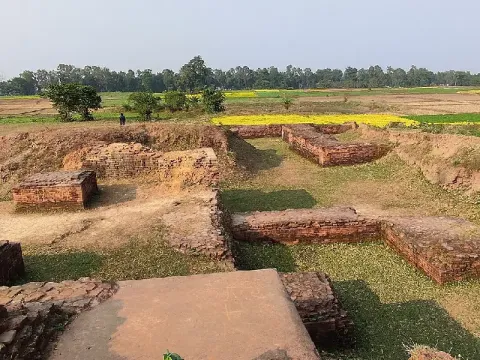
Excavations at Bangarh between 1938 and 1941 (led by K.G. Goswami of the University of Calcutta) and continued by the Archaeological Survey of India have revealed five distinct cultural layers across the site. The earliest phase, Mauryan in date, shows a settlement with a modest mud-rampart wall, probably the very beginnings of what would become one of Bengal’s great cities. During the Kushana period (roughly 200 BCE – 300 CE), the city expanded dramatically: a wide brick-built rampart wall appeared, along with drains, cesspits, and residential buildings of large burnt brick, all indicating a prosperous, organized urban community. Kushana gold coins have been recovered here as well as at Mahasthangarh, confirming the city’s integration into the wider sub-continental economy.
Following a relative lull in building activity during the Gupta period, the subsequent Pala era (mid-8th to 12th century) ushered in a spectacular reversal with significant urban growth. Rampart walls were rebuilt, residential quarters expanded, damp-proof granaries were constructed within housing blocks, and temples were equipped with ambulatory paths for ritual circumambulation. A lotus-shaped tank, likely intended for ceremonial purposes, was constructed, featuring a pillared canopy that exemplifies the characteristic refinement of Pala architecture. Clay seals bearing Brahmi inscriptions from the Maurya period have been recovered from early excavation layers, and terracotta figurines from the Shunga period attest to the artistic life of the city in its earlier centuries.
The 12th-century polymath Hemachandra compiled a remarkable list of names (Kotivarsha, Banapura, Devikota, Umavana, and Shonitapura) all referring to a single city. This list is significant as it connects the archaeological site to both the Puranic legend of king Bana (son of Mahabali and devotee of Lord Shiva) and to actual place-names used throughout the medieval era. Mythology and history have always been deeply intertwined here.
Comments